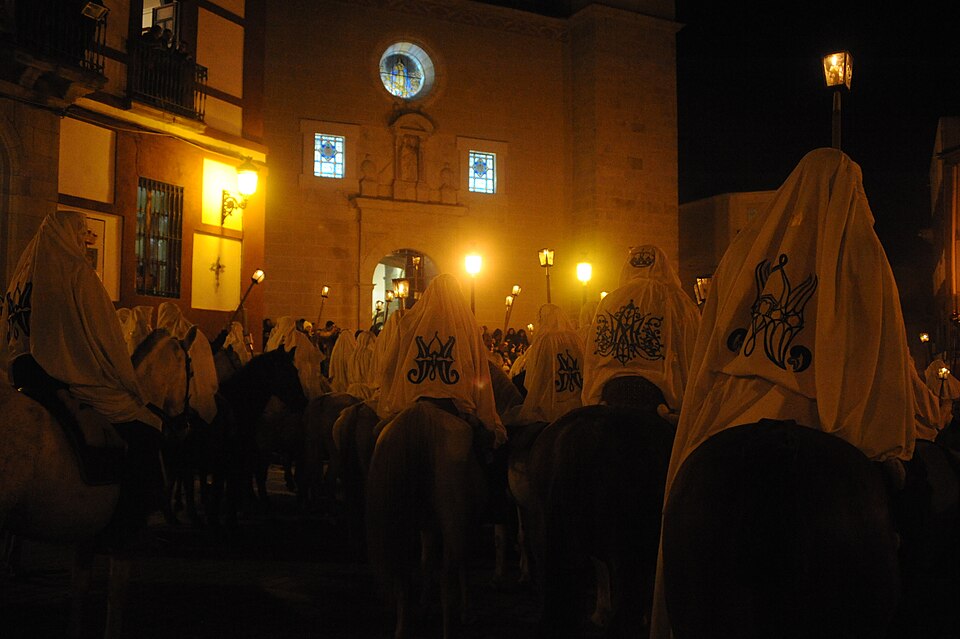
Photo: Herrero Uceda · CC BY-SA 3.0 · Wikimedia Commons
Patron saint festival Regional Tourist Interest
La Encamisá en Torrejoncillo
Torrejoncillo, Cáceres · Extremadura
2026 edition
5–8 December 2026
✔ Official dates confirmed
2026 programme
- 14 November, 21:00 · Extraordinary general meeting of Paladines: presentation of the programme, poster, festival announcer and person making the offering; selection of the standard-bearer by drawing lots. Second call at 21:30. (Casa de Cultura «Raúl Moreno» in Torrejoncillo)
- 5 December · Festival opening address
- 6 December · Floral offering
- 7 December, 22:00 · Departure of the banner of the Inmaculada and La Encamisá procession (Iglesia de San Andrés and streets of the town centre)
- 8 December · La Pura
- 8 December · Main Mass of the Inmaculada Concepción (Iglesia de San Andrés Apóstol)
- 8 December · Solemn procession of the Inmaculada (Streets of the town)
- 8 December · Refreshments offered by the mayordomos
Sources: torrejoncillotodonoticias.com · hoy.es · torrejoncillo.es
Where it is and getting there
Iglesia de San Andrés Apóstol · Torrejoncillo
Sources: pueblosdefiesta.com
Introduction and local significance
La Encamisá in Torrejoncillo, in the province of Cáceres, takes place from 5-8 December 2026 and is dedicated to the Inmaculada Concepción. Its most characteristic sight is that of riders covered in white sheets accompanying the Virgen’s banner through the streets of the town.
The Extremaduran festival is recognised as being of Regional Tourist Interest. For visitors, it brings together several customs that offer an insight into Torrejoncillo: the riders’ lanterns, the traditional dress worn for the floral offering and the sweets handed out during the celebration.
Historical origins and tradition
The origins of La Encamisá have not been established, and there are several interpretations. Domínguez Moreno places them in pre-Roman times and links them to the goddess Ataecina; López Bernalt connects them with an encamisada, a night-time military raid, during the siege of Coria in 1465, while Juan Moreno Lázaro places them in the war in Flanders, around 1585.
A local legend links the festival to the Battle of Pavia in 1525 and to soldiers camouflaged beneath white sheets, although there is no documentary evidence to support it. The festival was declared of Regional Tourist Interest in 1997.
On the night of 7 December, hundreds of riders covered in white sheets go to the mayordomo’s house to receive the lantern they will carry in La Encamisá. The sheets are decorated with lace and, in some cases, with golden stars or an image of María Inmaculada.
The sky-blue banner, embroidered with an image of the Virgen, is handed to the mayordomo, who rides on horseback accompanied by two other riders. During the procession, gun salutes are fired in honour of the Inmaculada; joritañas are lit in the small squares, and children burn jachas, bundles of gamonita prepared by their families.
Women and couples dressed in traditional Torrejoncillo costume take part in the floral offering. They walk through the streets and lay flowers at the feet of María in the church, a custom that links local dress with devotion to the Inmaculada.
The association Los Paladines de la Encamisá was founded in 1973 to help fund the festival, after there were no mayordomos in 1966 and 1968. The association takes on the mayordomía in even-numbered years and selects the standard-bearer by drawing lots among its members.
Religious preparations include a novena during the nine days before 8 December. A visiting priest takes part as preacher, so the celebration dedicated to the Inmaculada also includes events before the nocturnal procession.
Programme and main events
The banner procession is the focus of the nocturnal celebration of La Encamisá in Torrejoncillo, while the main Mass and solemn procession are dedicated to the Inmaculada. This guide provides the official programme for this edition, with the venues and times available.
Before the festival dates, the extraordinary general meeting of Paladines takes place on 14 November at the Casa de Cultura «Raúl Moreno». The programme, poster, festival announcer and person making the offering are presented there, and the standard-bearer is selected by drawing lots; the meeting is called for 21:00, with a second call at 21:30.
Traditional festival food
Sweets and wine accompany the night of La Encamisá, while the mayordomos offer caldos de tomate, local tomato broths, after the procession. It is worth distinguishing between what is handed out during the night and what is served after the religious event:
- Coquillos: sweets offered after the procession.
- Caldos de tomate: local broths offered by the mayordomos after the procession.
- Cañas: traditional sweets handed out during the night.
- Local wine: also handed out during the nocturnal celebration.
These products are associated with different moments of the festival, so they can be found both during the nocturnal celebration and after the procession. Coquillos and cañas are the two sweets mentioned for the festival.
Visitor guide and where to stay
The Iglesia de San Andrés Apóstol and the streets of the town centre are the main landmarks to help you find your way during the festival.
If you plan to follow the route through the streets, be aware of the horses and the use of shotguns, and follow the instructions of the security team. The Ayuntamiento recommends checking the times for each edition before travelling.
For anyone who decides to take part in the run, the Ayuntamiento advises wearing old clothes made of non-flammable fabric, covering your head and protecting your hands and neck. Participation is a matter of personal choice, so it is worth bearing these recommendations in mind when planning your visit.
To follow the evening events, you can stay in Torrejoncillo or in nearby towns.
Spotted a mistake or something missing? Suggest a correction · How we work