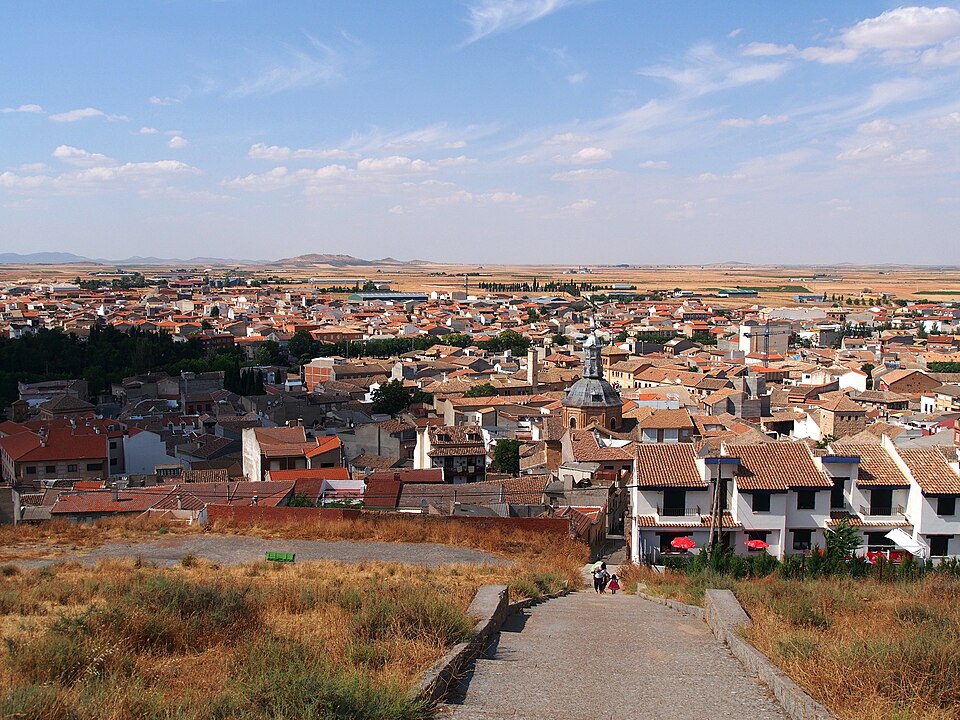
Photo: rheins · CC BY 3.0 · Wikimedia Commons
Patron saint festival Regional Tourist Interest
Fiesta de la Rosa del Azafrán en Consuegra
Consuegra, Toledo · Castilla-La Mancha
2026 edition
17–25 October 2026
✔ Official dates confirmed
2026 programme
- 17 October, 19:00 · Gathering of the Dulcinea, Female Town Crier and Authorities at the Town Hall and parade to the Don Quijote Theatre-Auditorium (Consuegra Town Hall)
- 17 October, 19:30 · Act of Proclamation of Dulcinea 2026 (Doña Soledad Tendero Perulero), Opening Speech and La Mancha Exaltation Act by Doña Carolina Palencia García, and performance by the Traditional Dance Schools and the 'Rosa del Azafrán' children's choir and dance group (Don Quijote Theatre-Auditorium)
- 18 October, 12:00 · Firecracker announcing the start of the fiestas from the main balcony of the town hall and distribution of sweets (Town Crier: Urbano Jiménez Soto) (Plaza de España)
- 18 October, 12:30 · 13th 'Rosa del Azafrán' Rondas Gathering (Calle del Arco)
- 18 October, 19:00 · 10th Consuegra City Rondallas Gathering (Don Quijote Theatre-Auditorium)
- 23 October, 17:00 · Local Saffron Peeling Contest in its children's category (Former Convent of the Franciscan Fathers)
- 23 October, 18:00 · Local Saffron Peeling Contest (Adults' Category) (Former Convent of the Franciscan Fathers)
- 23 October, 18:00 · Inauguration of exhibitions (Posters, Painting and Centenary of the Santísimo Cristo de la Vera Cruz School) (Various locations (Tourist Office, Archaeological Museum, Santísimo Cristo School, La Vida de Antes Hotel))
- 23 October, 19:00 · Inauguration of the Agricultural Machinery and Vehicles Fair (Paseo Ramón y Cajal)
- 23 October, 19:30 · Inauguration of the Agri-Food Fair (Marquee on Paseo Ramón y Cajal)
- 24 October, 09:00 · Local Tractor Skill Contest. Ploughing (Silo Monroy)
- 24 October, 10:30 · 27th Saffron Rose Gastronomic Contest (Paseo José Ortega y Munilla)
- 24 October, 11:00 · 'Land of Saffron' guided routes (Consuegra)
- 24 October, 16:00 · Provincial Saffron Rose Peeling Contest (Adults' Category) (Former Convent of the Franciscan Fathers)
- 24 October, 16:30 · Performance by the Municipal School of Music (El Rucio windmill esplanade)
- 24 October, 17:00 · 61st Peace Grinding (dedicated to Medieval Consuegra) and distribution of commemorative bags of flour (El Rucio Windmill)
- 24 October, 17:30 · Folklore Exhibition at El Rucio Windmill (El Rucio Windmill)
- 25 October, 09:00 · Morning Musical Wake-up by the Municipal Music Band
- 25 October, 11:00 · Local Tractor Skill Contest (Trailer) (El 'Campillo')
- 25 October, 11:00 · Reception of the groups participating in the 64th National Folklore Festival by Authorities and Dulcinea (Town Hall Plenary Hall)
- 25 October, 11:00 · Final of the Saffron Rose Children's Peeling Contest (Plaza de España)
- 25 October, 11:30 · Final of the Saffron Rose National Adults' Peeling Contest (Plaza de España)
- 25 October, 12:30 · 64th 'Rosa del Azafrán' National Folklore Festival (Plaza de España)
Sources: Web oficial del Ayuntamiento de Consuegra (aytoconsuegra.es) · Ayuntamiento de Consuegra · aytoconsuegra.es
Introduction and local significance
The Fiesta de la Rosa del Azafrán in Consuegra is one of the most deeply rooted autumn celebrations in Castilla-La Mancha. This event pays tribute to the harvesting of La Mancha's so-called "red gold" and the traditions linked to its cultivation. Declared a Festival of Regional Tourist Interest, the festivity attracts a multitude of visitors to the Toledo municipality of Consuegra to witness the artisanal work surrounding this prized spice.
For this edition, the official activities take place from 17 to 25 October 2026. Throughout these days, the town combines folklore contests, gastronomic displays and agricultural exhibitions at the foot of its iconic windmills. The figure of the Dulcinea, popular music and traditional competitions complete a cultural programme deeply tied to the landscape and history of La Mancha.
Historical origins and tradition
The origin of the festival dates back to 1963, when it was officially established to pay homage to saffron and protect the customs linked to its cultivation. The agricultural process begins at dawn in the saffron fields with the manual harvesting of the flower, a meticulous task that requires pulling the whole rose before the sun withers its petals. Afterwards, the peeling ("monda") of the rose is carried out, which consists of skilfully separating the three red stigmas of the flower for immediate roasting and preservation.
This artisanal labour becomes a public spectacle through various saffron rose peeling contests. These trials measure the speed and neatness of the participants in peeling exactly one hundred roses, divided into children's and adults' categories with local, provincial and national final phases. Traditional Castilian attire is worn by the local and children's groups participating in the Folklore Exhibitions and the "Rosa del Azafrán" National Folklore Festival.
Other consolidated traditions include the established act of the Proclamation of the Dulcinea and the La Mancha Exaltation, accompanied by the inaugural opening speech. Likewise, within the framework of Cerro Calderico, the Peace Grinding ("Molienda de la Paz") is held in historical windmills such as El Rucio or Sancho, where traditional machinery grinds grain to distribute commemorative bags of flour. The festive calendar also integrates the gathering of rondas (musical groups) through streets such as Calle del Arco, tractor skill competitions in ploughing and trailer categories, morning musical wake-ups ("dianas floreadas") and the recreation of traditional La Mancha scenes during culinary exhibitions.
Programme and main events
The celebrations of the Fiesta de la Rosa del Azafrán in Consuegra structure their calendar across more than a week of activities. Among the most representative events are the opening speech and the proclamation of the Dulcinea at the Don Quijote Theatre-Auditorium, as well as the traditional firecracker ("chupinazo") from the Town Hall balcony. In the final stretch, highlights include the gastronomic contest on Paseo José Ortega y Munilla, the Peace Grinding at El Rucio Windmill and the final phases of the National Peeling Contest alongside the National Folklore Festival in Plaza de España. Details of all events, times and confirmed venues can be found in the official programme summary above.
Traditional festival food
The traditional cuisine of the region takes centre stage during the 27th Saffron Rose Gastronomic Contest, where popular dishes prepared according to traditional La Mancha recipes of yesteryear are cooked and tasted:
- Asadillo: Traditional La Mancha roasted pepper salad prepared and presented at the Gastronomic Contest.
- Pisto Manchego: Traditional slow-cooked vegetable stew.
- Caldereta de cordero: Traditional lamb stew.
- Pote campero: Traditional rural stew from La Mancha.
- Gachas: Typical dish traditionally prepared in a frying pan.
- Rin Ran: Traditional La Mancha preparation competing in the gastronomic contest.
- Migas: Traditional dish made from chopped bread and accompanied by various ingredients.
- Sopas cabreras: Typical traditional soup from La Mancha.
Visitor guide and where to stay
To obtain in-person tourist information during the festive dates, the municipal Tourist Office is located within the Bus Station facilities, situated on Avenida Castilla-La Mancha, without number.
When planning your attendance at events in the Don Quijote Theatre-Auditorium—such as the Proclamation of the Dulcinea, the Opening Speech or the Rondalla Gathering—please keep the following logistical instructions in mind:
- Prior collection of tickets is mandatory on the www.giglon.com platform or at the theatre box office.
- Box office opening hours are Thursdays and Fridays from 11:30 to 13:30, Thursdays from 18:30 to 20:30, or two hours before the start of the show.
- The "Land of Saffron" ("Tierra de Azafrán") guided routes require mandatory prior booking by email at info@aytoconsuegra.es or via WhatsApp message at 627905216.
Spotted a mistake or something missing? Suggest a correction · How we work